
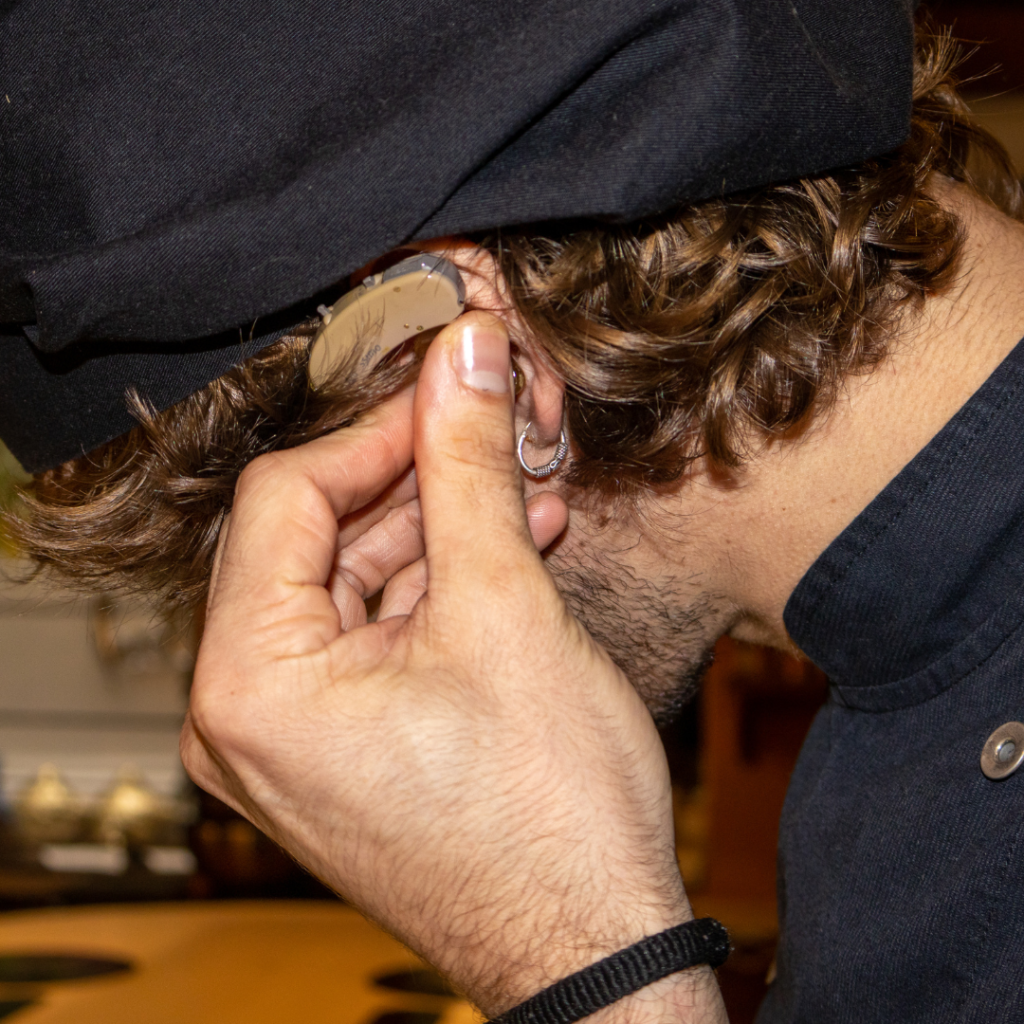
Maintaining dinner dialogue proves demanding when chaotic ambient noise strains your concentration and hearing. We perform comprehensive diagnostic assessments to evaluate hearing in quiet rooms and challenging acoustic spaces to identify functional deficits. After uncovering the precise factors driving your difficult hearing, our team helps you select individualized auditory solutions.
How Can Hearing Seem Normal at Home but Fail in a Restaurant?
Quiet rooms provide a favorable signal-to-noise ratio, meaning a speaker’s voice is much clearer than the sounds around it. Busy dining establishments generate the exact reverse scenario. Layered diner voices, kitchen activity, foreground music, and room reverberation muddy speech signals, requiring intense mental strain to follow dialogue.
Such listening challenges typically stem from high-frequency hearing loss, auditory-processing deficits, or accumulated noise-induced trauma. Poor visual illumination, mental fatigue, physical distance from the speaker, and divided focus exacerbate speech-recognition problems. It is common to display normal baseline audibility on conventional hearing tests while failing comprehensive speech-in-noise testing. Inability to track speech in crowded restaurants merits audiological evaluation even when standard daily hearing sounds completely normal.
Clinical Evaluation of High-Frequency Hearing Loss
Diagnostic assessment begins by documenting specific listening breakdowns, recreational noise exposure, tinnitus symptoms, medications, and hereditary auditory patterns.
Clinical pure-tone audiometry identifies hearing threshold levels across various frequencies by delivering sounds through air and bone pathways. Patients with high-frequency hearing loss typically exhibit a sloping audiogram configuration where sensitivity steadily declines at elevated pitches. Extended test batteries incorporate acoustic tympanometry to rule out middle-ear pathology along with suprathreshold word-recognition testing.
A quiet sound booth cannot replicate complex dining room acoustics, which makes clinical speech-in-noise testing especially informative. It calculates your ability to identify verbal phrases as competing background noise levels rise. Together, these results show whether the problem involves audibility, speech clarity, background-noise processing, or a combination of factors.
Auditory Processing Disorders: Impact on Adult Communication
An auditory processing disorder compromises how the central auditory pathways and brain decode incoming acoustic information. While peripheral ears may register soft tones normally, the auditory cortex struggles to filter competing noise, resolve phonetic contrasts, or keep pace with rapid conversation. We first rule out peripheral sensorineural deficits before deciding whether a dedicated auditory-processing test protocol or specialist referral is indicated.
Effective Techniques to Hear Better in Noisy Surroundings
Simple situational adjustments enhance the speech signal entering your ears and offer clearer facial cues. Before heading out to eat, select dining spots with quieter acoustic profiles or dine during low-volume hours. Venues with booths, acoustic panels, curtains, carpeting, and other sound-absorbing features may be easier than open rooms filled with hard surfaces.
Practical seating strategies in the dining room:
- Reserve a table located well away from kitchen doors, active bar counters, overhead speakers, and banquet groups.
- Situate yourself with a structural wall behind you to minimize distracting ambient noise from behind.
- Position yourself to directly face companions under bright lighting to enhance facial comprehension.
- Keep conversational proximity as close as comfortably feasible to preserve acoustic signal strength.
- Place your better-hearing ear toward the person you most want to hear.
- Ask speakers to reword the specific phrase you missed rather than repeating their initial wording.
- Explicitly repeat back important logistical details instead of pretending you caught every word.
- Take a brief listening break when fatigue begins to build.
- Request that friends speak with crisp clarity rather than speeding through dialogue.
- Speaking with excessive volume creates acoustic distortion that fails to make words clearer.
The Best Hearing Devices for Overcoming Restaurant Noise
Determining the proper hearing technology hinges on the underlying disorder, everyday listening environments, and whether peripheral hearing loss is diagnosed. Advanced hearing aids utilize beamforming directional microphones, adaptive noise reduction, and specialized restaurant programs to elevate voices directly ahead while suppressing ambient chatter. Users should establish realistic expectations because no hearing device can fully eradicate all unwanted ambient speech.
Wireless remote microphones provide the most effective enhancement to real-world signal-to-noise ratios. Clipped near the speaker’s mouth or set nearby, the transmitter sends voice signals wirelessly to matched hearing aids or a receiver. This reduces the effects of distance and surrounding noise.
Further practical hearing technology options include:
- Table microphones for small-group conversations
- Telecoil sensors configured to access hearing-loop broadcasts in looped facilities
- Mobile device live-captioning programs and speech-to-text transcription software
- Consumer wireless earbuds or hearables featuring customizable assistive listening modes
- Sound-level meter applications and community-driven quiet dining guides
Our audiology staff helps you evaluate options, ensures wireless compatibility, and trains you on operating your chosen equipment.
The Clinical Role of Audiologists in Managing Loud Environments
A hearing evaluation can move the conversation beyond “I hear fine in quiet.” We analyze the exact social venues, voice registers, and noise environments that cause difficulty to administer tests matching your lifestyle. The diagnostic battery may encompass pure-tone thresholds, acoustic middle-ear evaluations, suprathreshold word recognition, and speech-in-noise measures. Dedicated central auditory-processing testing will be scheduled if your history and primary diagnostic testing indicate central pathway issues.
Any sudden, asymmetric, or rapidly deteriorating hearing loss demands immediate medical evaluation by an ear, nose, and throat physician. Individualized diagnostic care pinpoints the precise physiological etiology rather than merely blaming restaurant noise for communication struggles.
Request an Audiology and Hearing Evaluation Today
If dining in loud spaces leaves you feeling isolated, fatigued, or guessing at missed speech, contact us to schedule a thorough hearing evaluation. We can explore ways to help with hearing in noisy environments with hearing-aid adjustments, assistive tools, or rehabilitation options that may fit your needs.
Connect with us today to arrange your clinical visit and take the first step toward clearer, easier dining communication.